Training in the Sea of Cortez: A Guide’s Sea Kayak Baja Experience
October 20, 2026
Training in Baja
Ever since I started kayaking I’ve loved the photos of all the exotic places people paddled. Photos of kayaks that seemed to float over the ground on crystal clear water, photos paddling by rocky shores with towering trees, shrouded in mist, photos of kayakers paddling by sheets of ice with gradients of white to blue that just seemed unreal. My bucket list for places to paddle just kept getting longer and longer! So when the opportunity to check one of those places off my list arrived, of course I was going to jump in.
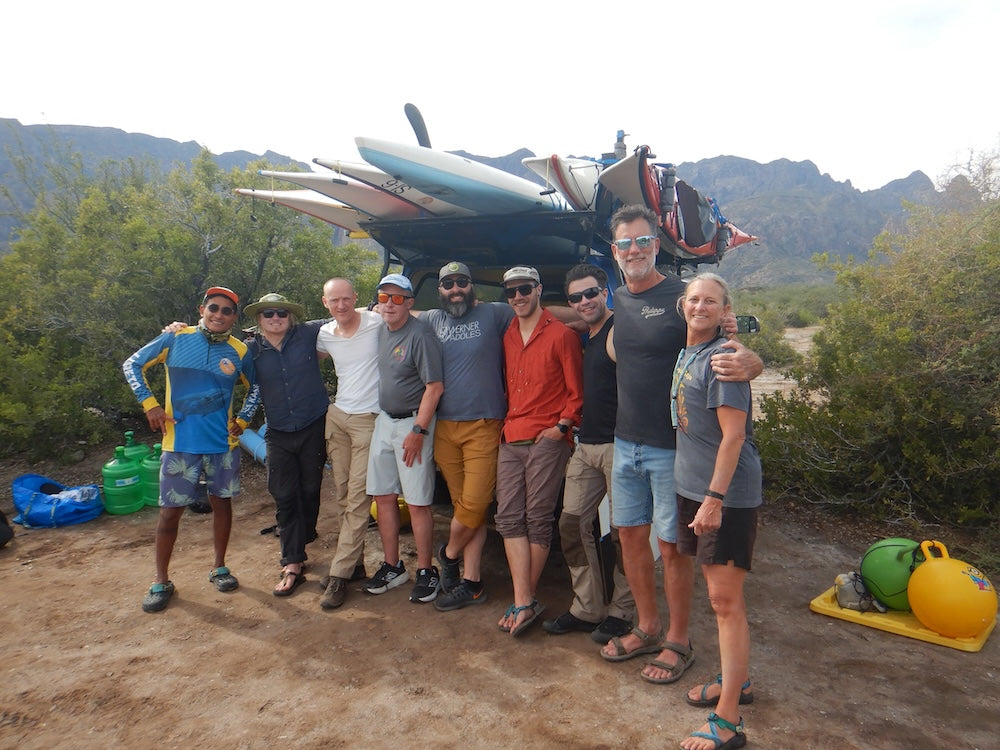
Alder Creek sent three guides to Loreto Mexico for some sea kayak training with expert kayaker and owner/operator of Sea Kayak Baja, Ginni Callahan. Nate, E, and myself were the lucky guides able to make the trip. After figuring out who could go in early December, we got tickets, found lodging, and eagerly awaited the start of our trip.
Arriving in Loreto
Our day started with an early flight from Portland to Loreto with a layover in LAX. I was surprised by how busy the airport was at 5:20 am. While a lot of people seemed to be chasing the snow, we had our sights on warmer adventures. After an hour in line to drop off our bags and have our passports checked, it took another hour to get through security. We laughed and joked as we waited but I was silently sweating as I’ve never cut a flight so close after arriving so early. To add to the drama, my backpack got flagged by security. Apparently my marine radio looked odd on the scanner without the antenna attached. With that cleared up we had just enough time for a pit stop to refill water bottles before walking onto the plane.
Smooth flights got us to Loreto around 2:40. As soon as we stepped off the plane I was reminded of a trip last year to Arizona. The rocky landscape with large cacti reminded me of the Sonora Desert, which it turns out, Baja is a part of. We made it through customs and collected our bags before getting a taxi ride to our Air B&B.
After dropping our bags, Nate and I walked the plaza by the church before we had to meet at Sea Kayak Baja headquarters for a meet and greet, gear fitting, and overview of the next four days together. There was a lot of activity with booths and vendors setting up in the plaza. It turns out we had arrived the day of a celebration for the Blue Whales that spend time in the Sea of Cortez. That evening they had music, dancing, and food along with info booths about these majestic creatures. We would keep our eyes peeled the rest of the trip but unfortunately never saw whales.
Day 0
We arrived at Sea Kayak Baja where we met the team. Our guides Ginni and Niké showed us our boats, and we met our fellow students Tom, Steve, Rob, and Bart. We sat in our kayaks to check the fit and selected a paddle for the trip. I was excited to paddle a composite kayak and use a Werner Cypress. Nice quality gear makes a difference. The selection was impressive with Greenland, Euro, and Wing paddles to choose from in various lengths. After getting that set we adjourned to a small room to discuss the trip and plan the days.
We started with a little more about ourselves and what we wanted from the trip. I’m very confident in my on water skills, but was hoping to strengthen some areas I don’t get to exercise as often. With input from everyone we had a nice list of skills to emphasize over the next 4 days. Next we looked at the weather.
January and February are usually windy times in the Sea of Cortez and I was looking forward to paddling in some rougher waters. As always Mother Nature seemed to have different ideas. The next day would have 10 to 15 kt winds, then dropping to 3 kt for the remaining three days. Nightly lows would be 66, fifteen degrees warmer than Portland’s daily highs. And the highs would be right around 70, the forecast I dream of for our San Juan trips.
It was decided that after after picking up the clients and dropping everything at our campsite, we would head to Playa Juncalito and take advantage of our one day of wind. We finished the night by grabbing the rest of the gear we might need to borrow, PFDs, paddle jackets, snorkeling gear, tents, sleeping bags, Sea Kayak Baja had it all. Then we wrapped up day zero and got ready for Day 1.
Day 1
Nate, E, and I woke up early and got our things organized. Leaving them in our room we headed out to find breakfast. We decided to try the cafe a stone’s throw from our Air B&B called Cafe Olé. Turns out we weren’t the only ones! Steve and Tom joined us there. The food was really good. I had never had cactus before, so I ordered a scramble that featured cactus along with a glass of orange juice. We chatted about paddling and what we were excited about in the coming days. All too soon it was time to meet the Taxi for pickup.
Niké arrived with the Taxi and we loaded our bags into the back of the van before piling in. Soon we were driving out of Loreto and heading south towards our beachfront campsite for the next three nights.
The campsite was surrounded by brush and Mesquite trees. We had a red rocky ridge dominating the view behind us and Isla Danzante in front. Almost everyone set up their tent on the beach, overlooking the water. We got things roughly set up, and got ready to go paddle!
A short drive later we were on the beach unloading our kayaks. The waves were small, 1 to 1.5 foot with a very short period as they were being generated by the Northern winds. After observing the water for a while we packed up our boats and got ready to launch.
On the outside we gathered up before starting our paddle into the bay. To help remember names we played games as we paddled that involved using everyone’s name. It was great for remembering and helped manage the group, keeping us closer together.
After a while we had our first exercise, rescues. We had some time to practice any rescue we wanted with a partner. I did a roll on both sides. My partner did a solo scramble.
After rescue practice in the relatively sheltered water of the bay we continued toward a small island at the eastern mouth of the bay. The wind was stronger on the outside and we wanted to practice more rescues in the chop. As we went we played leap frog in our kayaks. It was fun trying to keep a slow and steady pace while boats would sprint ahead.
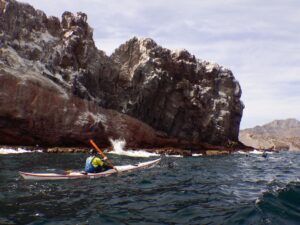
As we got closer to the island it became clear the stronger wind wasn’t getting any closer. That was alright though, the east side of the island was a shelf that dropped off into noticeably deeper water. This meant the swells were bouncing off the rock, creating an area of larger, choppier water than what we had experienced in the bay. We cruised the rougher water before trying our rescues again. I did rolls again and then tried my scramble. All three felt really good and I appreciated that the water was warmer than what I had been paddling recently in the Columbia River.
After rescues we finished a circuit around the small Island before heading back to the beach. We quickly reviewed landing procedures before making our way in. I got to catch boats while Ginni demonstrated a back deck rescue through a surf zone.
Once everyone was safely on the beach we broke out sandwiches and grapes for lunch. While eating we discussed our plans for the afternoon. Ginni and Niké would give a surf zone clinic for those who wanted to practice and learn more about launching and landing, and anyone else could take advantage of the small waves. After that we would load up and head back to camp, either by car or by paddling.

Nate, E, and I elected to surf the small waves. We had so much fun sliding down the faces and trying to maneuver for the longest rides we could manage. After some fun Ginni had some challenges for us. “How might you stay higher on the wave rather than running ahead?” she asked. We began working on the puzzle. I decided to try three things, back strokes for drag, taking off later to start higher on the wave, and more turns to not slide down as quickly.
I had a little success, most influenced by taking off a little later so I started more on top of the wave, which made everything else easier. After a practicing for a while Ginni caught my eye after a run and mimed sitting before rocking backwards and forwards. Message received, use body weight to adjust trim on the wave! After an hour more playing in the surf we were getting tired, so I landed for a breather. I hadn’t yet mastered my surfing, but I had some really good tips to continue dialing in my form and continue improving.
After surfing Nate, Steve, and Niké loaded up to drive back to the campsite while Ginni, Tom, Rob, E, Bart, and I paddled back to camp. We estimated a five mile paddle out and around Punto Coyote. We chatted on our way out of the bay before cruising the rocky cliffs of the point. The water got a little bigger with swells reaching 3 to 4 feet on occasion. Ginni broke out more games and challenges including a lateral slalom which challenged our boat control in the rougher conditions.
After rounding Punto Coyote, the wind and swell dropped and we paddled the last mile to our campsite in relatively calm waters. After landing we stored our boats for the evening and started relaxing, talking about our experiences from the day. We talked about the Frigate Birds that had an arial battle trying to steal a fish from each other. The rays that would leap out of the water flapping their wings before splashing back into the water. And personal wins for the day.
My own personal win was after a flip while surfing. I rolled up after the wave had passed and, because of the short period, got immediately got slammed by the next wave while my eyes were still closed with water streaming down my face. I reacted by leaning into the wave and throwing down a low brace. The wave passed and I had remained upright!
Niké made an amazing dinner of Mole Chicken as we watched a beautiful sunset behind the mountains. We wrapped up the night and crawled into bed under the stars.
Day 2
After the first night I realized I had made a mistake. Remember the forecast of lows in the mid 60s? I tried saving room by bringing a lighter weight blanket instead of my sleeping bag. It wasn’t enough. Fortunately after putting the tarp on to retain some heat, dressing in all my warm layers, and using my towel as an additional blanket I was able to sleep comfortably through the night. Lesson learned again. The right gear matters.
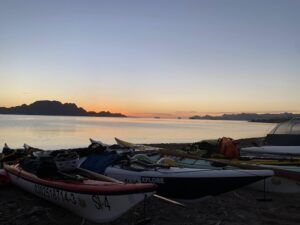
As the sky brightened, we all stirred awake to watch the sunrise. Ginni greeted the morning with her flute. The wind instrument floated its notes on the morning air. The delicate tune dancing through camp as the sun started to peek over the horizon. This would become a morning ritual.
We had another wonderful meal before getting into our morning session. This morning we were examining some coaching concepts and self assessment. We looked at “The Learning Target” finding the challenge sweet spot for optimal learning, and the four aspects that we need to train: Physical, Psychological, Technical, and Tactical. We discussed these topics using our session the previous day as a reference and reflected on our successes and hardships using these new tools.
Then it was time to get on the water. We launched into a calm sea and had an impromptu balance challenge. E likes to do what they call SUKing, or Stand Up Kayaking. Some of us tried standing in our kayaks to emulate their achievement. No one could match E’s success. What we could do was sit on the back deck with feet in the cockpit, or spin around working on maneuvering in our boats. It was great fun sitting on the hatches and crawling around on the deck.
Our first official exercise was to break into groups and work on our forward strokes. I’ve spent many hours over the years talking about the forward stroke and helping students improve, but haven’t had my own stroke analyzed in years. I found it very interesting, and helpful, to learn that my stoke looked good until I increased my cadence. When I wanted to go faster I fell into the trap of pulling when feeling the loaded paddle instead of rotating. My paddler’s box collapsed, shortening my stroke and using all the wrong muscles. I did go faster, but I was wasting energy.
We paddled back to Punto Coyote and landed on a small beach on the south side of the Point. On the beach we discussed rescues. We walked through our assisted rescue and discussed a few different techniques for the various stages of the rescue along with their pros and cons. I really liked Ginni’s cue for the Heel Hook of being a sea star before reaching across the boat. This felt like it helped cue rolling onto the back deck instead of climbing on.
While everyone else practiced rescues, I was itching to take advantage of the clear water and my snorkel. There were rooster fish skimming the surface off the point all morning, and Dolphins had cruised past as we had arrived at the beach. Nike said it was a great place for diving, and he wasn’t wrong.
I swam out, put my dive watch in dive mode, excited to see how deep it was and how long I could explore under water on a single breath, then watched in horror as my watch said “low battery” and shut off. That was the last I would be able to tell time the whole trip! I quickly got over it, it was water time.
Schools of fish cruised just under the surface, their bright yellow bodies surrounding me as I swam by. I dove down exploring the rocky structure. The depth increased quickly as I explored around large boulders. Parrot fish and puffer fish cruised along looking for snacks. On one dive as I cruised around a rock, I spotted a Moray Eel tucked under a rock, sitting in its hole sticking their head out and watching me glide by. After five or six dives I started to get cold, so I swam back to shore and went spelunking in the tide pools.
Lunch was fantastic, guacamole on crispy tortillas, after which we paddled around the point to do some practice in the wind. We wanted to see how weather cocking effected boat handling and how we might use it to our advantage when maneuvering in wind. For a minute the wind looked like it was going to cooperate, and then died off as soon as we got around the corner. There was enough to just start to feel the effects, but it was so easy to overpower you didn’t get that clear and definitive feedback.
We paddled back to camp staring at the beautiful red rock range, contrasting beautifully against a bright blue sky. Back at camp I got to relax in my hammock as I wrote down the adventures from the day and made notes about what I wanted to remember.
After another amazing dinner we watched to sun set before crawling into bed.
Day 3
After waking up to flute song and watching the sunrise we had another amazing meal. Today was a relaxed morning as our water time was going to be in the afternoon and evening. We were going to use the full moon and do a night crossing. But first we had to plan.
We started our morning session with some radio practice, covering simple protocol and tips for clarity when communicating. For instance, when initiating contact, repeat the name you are hailing three times. Another one was to use single digits when communicating numbers with multiple digits. Since the radio channels are in the double digits it is much clearer to say “channel zero six” incase theres some static. This way you know you have heard both digits. Another example is “one five” since fifteen can sound like fifty, especially when talking about discount savings! This also comes in handy when communicating position. Latitude is two digits, 0 to 90 above or below the equator, and Longitude is three digits, 0 to 359 around the globe.
Next we looked at navigation and trip planning. We used satellite images with compass rose added to check our angles and set our bearings for the crossing. We also used features on the sides to help us calculate different stages of our journey and make sure we were keeping our pace. Once the calculations were set we had lunch and packed up for the 3.3 mile crossing.
The water was so calm and smooth during the crossing. We started on a layer of liquid glass as we glided towards Isla Danzante. About 1.1 miles into our crossing Isla Coronados became visible around Punta Coyote. Since we couldn’t see Isla Coronado on our satellite images used for planning, this was a helpful local tip given by our leaders. Between that and our side range we had planned for putting us on a line between Punta Coyote and Isla Blanco, we knew we are close to our 2.5 kt/hr pace.
During the second half of the crossing the wind came up slightly. This headwind slowed our progress slightly and gave us some lively little chop to paddle into. We powered through and made it to the island. Total crossing time ended up being an hour and forty minutes, just ten minutes slower than we predicted.
Once landed we got the dinner supplies out before hopping in the water. I went for a snorkel again while others explored the bay by kayak. While diving I saw so many puffer fish laying in little impressions on the sandy bottom. There were groups of the puffers which I had never seen before! There were also Sting Rays just hanging out as well. Once dinner was ready we all crowded around for a delicious meal together on the beach as we watched the sun make its way towards the mountains.
After dinner we explored the cove a little by foot. Ginni told us about some of the trees, plants, and cacti in the cove that were also found throughout the area. There was an overhang that created a sheltered cave area with soot stains that had been dated to before European exploration. Around the corner there was a midden heap with layers and layers of shells indicating seasonal visits to the area that dated back hundreds if not thousands of years. We marveled at the thick lips of the shells which indicated a healthy, nutrient rich environment.
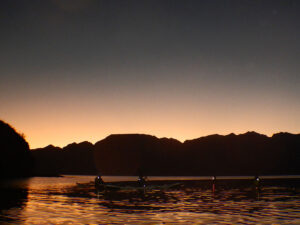
The sun was now completely behind the mountains and was reaching sunset, so we packed up our gear and got back on the water. I didn’t realize that there are three twilights, civil, nautical, and astronomical. I enjoyed the fact that astronomical is when the sun has dipped 18 degrees below the horizon. As light started to fade from the sky and the stars began to appear overhead, we slid across a shimmering see that reflected the sky above. The afternoon winds had died leaving us with a calm return journey across the water. As we reached the halfway point on our return, the full moon rose behind us, casting its light on the silhouette of the mountain range ahead. We purposefully shot for land north of our campsite because of more recognizable landmarks for a night crossing. Once we reached the shore we turned south to travel along the beach until we reached our camp. As we cruised along we started to hear splashes. Fish were jumping all around us! A school of hungry fish were feeding in the moonlight, accompanying us back to shore. We landed by moonlight and got ready for bed.
Day 4
The day started with another spectacular sunrise over the smooth waters as Ginni played her flute. After another fantastic breakfast we cleaned up and had a little free time before our first lesson. This morning Ginni told us the story about three tectonic plates and their epic clash that ended up creating Baja and the Sea of Cortez. It’s such a fascinating area with so many archaeological and geological stories to explore and share!
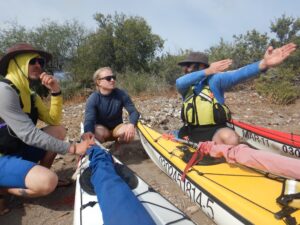
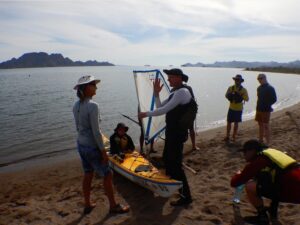
After story time we looked at rigging sails on kayaks. It was cool to see the setup and, as a knot geek, how it was rigged to the front deck. The wind didn’t really cooperate, but we paddled with the sails lowered and raised as we searched for whatever wind we could find to practice with. As we searched a pod of dolphin cruised by, leaping and splashing as they played.
We gathered back up for some playing of our own! With the sail deployed, E and I tried edging the kayak to get the mast to touch the water. It turns out my mast wasn’t centered because it was much easier to touch one side than the other. After that we practiced braces and rescues with the sails deployed. When self rescuing the sails didn’t really get in the way at all. They just fell to the side and you gathered them up as best you could before doing your rescue. Unless rolling. Then I just rolled and gathered the sail after.
At this point it was after noon so I went back to the beach to get my campsite broken down and packed up. Our transport arrived with a cooler of drinks and a hot bag of Tamales! There was a final wrap up as we ate and talked about key takeaways from the trip.
Finally it was time to load the kayaks onto the vehicles and head back to Loreto. We met up one last time for drinks at a local bar and talked about paddling adventures we have had, hope to have, and of course the one we had just shared together.
Baja is an amazing place. I’m so glad I got the opportunity to check it off my bucket list! Between the warm weather break in January, beautiful clear water, abundant wildlife, great food, and fantastic instruction, I don’t know that picking a single best moment is possible!
Thank you to Sea Kayak Baja for an amazing experience start to finish. I can’t wait to check out another adventure they offer and explore Baja again!
BY MATT MADDALENA